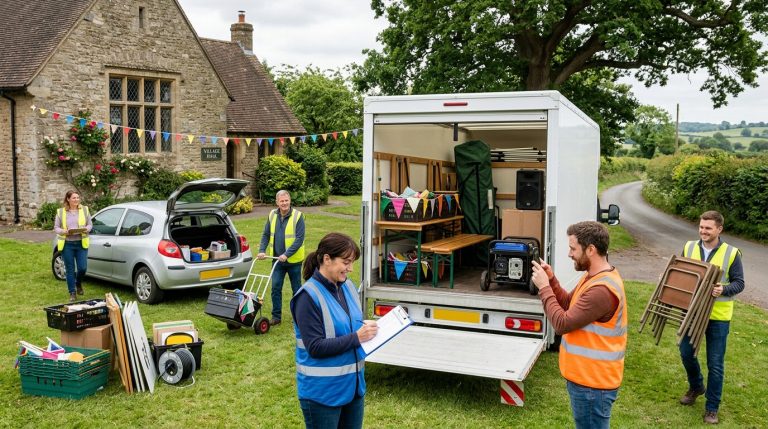

Most village events run on borrowed things. Trestle tables from the church hall, a gazebo from the cricket club, a PA system from someone’s garage, bunting from a box in the parish office. Getting all of it to the field on the morning, and back to the right owners afterwards, is a transport job that usually lands on whoever owns the biggest car.
A one-page transport plan fixes that. It lists every load, names one person responsible for each, and sets a return time before the event starts. Fill it in once and next year’s committee can reuse most of it.
1. List every load, with its size
Start with a walk round the people lending things. For each item, write down who owns it, where it lives, and its rough size and weight. “Six trestle tables” is not enough. “Six tables, 1.8m long, folded, two people to lift” is.
Length matters more than volume. A 3m gazebo pole or a stack of staging decks decides whether a car with the seats down will do, or whether you need a long-wheelbase van. Heavy single items, like a generator or a barbecue drum, point towards a vehicle with a tail lift or a ramp.
2. Give every load one responsible volunteer
Shared jobs are how things get left behind. Each load should have one named person who collects it, delivers it, and returns it. They can recruit helpers, but the name on the plan is the one the owner rings if the tables don’t come back.
For anyone driving a hired van, check their licence before the day. A standard category B car licence covers vehicles up to 3,500kg maximum authorised mass for petrol and diesel, according to GOV.UK’s licence categories page. Most Luton and large panel vans sit at that limit, so confirm the plated weight of the exact vehicle. If you are towing a trailer instead, the same page sets out the combined weight limits.
3. The reusable collection schedule
Copy this table into a shared document or print it for the committee. One row per load.
| Item and owner | Pick up from (place, time) | Size / weight | Vehicle | Driver | Return by (place, time) | Returned? (initials) |
|---|---|---|---|---|---|---|
| e.g. 6 trestle tables, church hall | Hall, Fri 6pm | 1.8m, 2-person lift | Hired van | Named volunteer | Hall, Sun 12pm | |
| e.g. 3m gazebo, cricket club | Pavilion, Sat 8am | 3m poles, 25kg bag | Hired van | Same volunteer | Pavilion, Sat 7pm | |
| e.g. PA system, private loan | Lender’s house, Sat 9am | 2 speakers, 1 desk | Volunteer’s car | Second volunteer | Lender’s house, Sat 8pm | |
The example rows are illustrative, not a real event. The last column is the one people skip, and the one that saves arguments in August.
4. Decide whether you need a hired van
If two or three cars can do it in one trip each, a van may not be worth the cost and paperwork. If the loads include long items, heavy items, or more than a couple of car-loads from different places, one van with a single responsible driver is often simpler. It also keeps volunteers’ own cars free of scratched boots and borrowed-tent mud.
Where you enquire depends on where your group is. The two examples below are for different parts of the Midlands. They are not a comparison, and you should confirm details directly whichever area you are in.
| Area | Enquiry example | What the page lists | Confirm before booking |
|---|---|---|---|
| North-west Leicestershire | Coalville van hire options | Small vans through to Luton tail-lift, dropside and tipper types | Exact vehicle, payload, load length, deposit, insurance excess |
| North Nottinghamshire | van hire information for Worksop | A similar range of panel, Luton and tail-lift vans | Delivery and collection times, licence checks, return time |
5. Check venue access before the day
A van that can’t get onto the field is a van parked in the lane with volunteers carrying tables 200 metres. Ask the landowner or venue:
- Which gate vehicles should use, and whether it is wide enough for a long-wheelbase van.
- Whether the ground holds up after rain, and where vehicles should stop.
- When vehicles must be off the field before the public arrive.
Larger public events may also need to involve the local council. Bassetlaw District Council, which covers Worksop, asks organisers to submit an event notification document so the event can be registered with its Safety Advisory Group, and it will say whether a meeting or a safety management plan is needed (Bassetlaw event planning and safety). Other districts have their own arrangements, so check with yours early.
6. Complete the return schedule
The event ends. Everyone is tired. This is when borrowed things go missing.
- Set the return times in the schedule before the event, and share them with the lenders.
- Load in reverse order of drop-off so the first stop’s items come out first.
- Before driving, do a quick walkaround. GOV.UK’s van walkaround guidance includes checking that the load does not move and is not likely to move.
- Return the hire van at the agreed time with the fuel level you were given, and photograph it.
- Initial each row when the item is back with its owner.
Keep the completed sheet with the committee papers. Next year, half the rows will be the same, and the hard part, knowing who owns what and how big it is, will already be done.
